


Page 220 - UNESCO_Zatec_2021_A4
P. 220
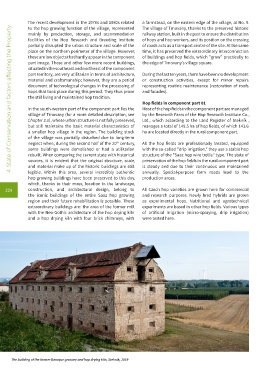
The recent development in the 1970s and 1980s related   a farmstead, on the eastern edge of the village, at No. 9.
      4. State of Conservation and factors affecting the Property
              to the hop growing function of the village, represented   The village of Trnovany, thanks to the preserved historic
              mainly by production, storage, and accommodation   railway station, built in the past to ensure the distribution
              facilities of the Hop Research and Breeding Institute   of hops and hop workers, and its position on the crossing
              partially disrupted the urban structure and scale of the   of roads acts as a transport centre of the site. At the same
              place on the northern perimeter of the village. However,   time, it has preserved the extraordinary interconnection
              these are low objects that hardly appear in the component   of buildings and hop fields, which "grow" practically to
              part image. These and other few more recent buildings,   the edge of Trnovany’s village square.
              situated in the southeast and northeast of the component
              part territory, are very utilitarian in terms of architecture,   During the last ten years, there have been no development
              material and craftsmanship; however, they are a period   or construction activities, except for minor repairs
              document of technological changes in the processing of   representing routine maintenance (restoration of roofs
              hops that took place during this period. They thus prove   and facades).
              the still living and maintained hop tradition.
                                                                Hop fields in component part 01
              In the south-western part of the component part lies the   Most of the hop fields in the component part are managed
              village of Trnovany (for a more detailed description, see   by the Research Farm of the Hop Research Institute Co.,
             Chapter 2.a), whose urban structure is not fully preserved,   Ltd., which according to the Land Register of Stekník ,
              but still maintains the basic material characteristics of   manages a total of 149.5 ha of hop fields, of which 143.6
              a  smaller  hop  village  in  the  region.  The  building  stock   ha are located directly in the rural component part.
              of  the  village  was  partially  disturbed  due  to  long-term
              neglect when, during the second half of the 20  century,   All the hop fields are professionally treated, equipped
                                                     th
              some buildings were demolished or had a  utilitarian   with the so-called "drip irrigation," they use a stable hop
              rebuilt. When comparing the current state with historical   structure of the "Saaz hop wire trellis" type. The state of
              sources, it is evident that the original structure, scale,   preservation of the hop fields in the rural component part
              and material make up of the historic buildings are still   is steady and due to their continuous use maintained
              legible.  Within  this  area,  several  incredibly  authentic   annually. Special-purpose farm roads lead to the
              hop growing buildings have been preserved to this day,   production areas.
              which, thanks to their mass, location in the landscape,
   220        construction, and architectural design, belong to   All Czech hop varieties are grown here for commercial
              the iconic buildings of the entire Saaz hop growing   and research purposes. Newly bred hybrids are grown
              region and their future rehabilitation is possible. These   as experimental hops. Nutritional and agrotechnical
              extraordinary buildings are: the area of the former mill   experiments are based in other hop fields. Various types
              with the Neo-Gothic architecture of the hop drying kiln   of artificial irrigation (micro-spraying, drip irrigation)
              and a  hop drying kiln with four brick chimneys, with   were tested here.


      The building of the former Baroque granary and hop drying kiln, Stekník, 2019

