


Page 372 - UNESCO_Zatec_2021_A4
P. 372
The building was financed by local citizens (among them   HOTELS
             were practically all the largest hop growers) and the
             town through an interim committee’s association. The   Hotel Zlatý anděl, The Golden Angel Hotel, No. 45,
             designer was the engineer Schulze, the builder Anton   Svobody Square
             Grimm. In 1871, gas lighting was introduced into the   The  Golden Angel  was one  of the most luxurious
             theatre. In 1910, an extensive internal remodelling was   accommodation, catering, and social facilities in
             carried out, including an artistically demanding painting   Žatec. Its long-term  owner was the company of the
             of the auditorium. The hop tradition is also demonstrated   well-known Žatec merchant, industrialist, and brewer
             on its curtain, which was painted in 1946 by Oskar Brázda.   Anton Dreher. The owners leased their business to
             At present, the theatre is still fully functional and serves   many operators. After World War II, the famous hotel
             its purpose well.                                  became public property. Since then, as evidenced
                                                                by the chronicler’s records of the town of Žatec, it
             The Elysium Cinema, No. 230, Obránců Míru Street   slowly fell into disrepair. The hotel underwent a
             The Elysium cinema, today the Lučan cinema, was built   complete renovation in 2018 and is now used for
             in 1928-1932, with great emphasis on the quality of the   accommodation again.
             interior; the projection hall was utterly equipped with
             vegetative paintings. The rich cultural and social life of   Hotel Družba, No. 56, Svobody Square
             the town is also evidenced by the fact that in the 1920s   Originally the Hanslik hotel of Friedrich Proft from 1900,
             there were two separate cinema buildings in Žatec (the   it was rebuilt in 1927-1930. The magnificent building
      7. Documentation  Bank, No. 236, Obránců míru Street      social spaces of the hotel, in which marble panelling was
                                                                was used to accommodate incoming hop merchants,
             second building disappeared during World War II).
                                                                which corresponded to the representative concept  of
                                                                massively applied. However, even the hotel’s rich owner
             The magnificent building of the former Austro-
                                                                was unable to give up the high income generated by hop
             Hungarian State Bank was built by the builders Fuchs
             & Kolbe in collaboration with the architect J. Salomon
                                                                growing, which is why also a hop warehouse is part of the
             before the First World War (before 1914). The combined
                                                                parking cars.
             roof covers the dominant two-storey mass with an "E"-
             shaped ground plan. A pair of bay windows complete   hotel complex. Its the first storey served as a garage for
             the  main  facade.  The  appearance  of  the  building  is   Hotel Zlatý lev, The Golden Lion Hotel, No. 228,
   372       completed by classicising decoration with the influence   Oblouková Street
             of modernity.                                      The original hotel building in Oblouková Street, from
                                                                1902, already in  the 1920s did not  have sufficient
                                                                capacity due to the increasing interest of visitors
                                                                to the town, so in 1931-1932 another building was
                                                                added to it. The building still serves its original
                                                                purpose today.


                                                                WORK IN A HOP WAREHOUSE AND PACKAGING ROOM

                                                                At the turn of the 19  and 20  centuries, work on hop
                                                                                  th
                                                                                          th
                                                                fields was very diverse and physically demanding.
                                                                This was also true of the work in hop drying kilns and
                                                                especially in hop warehouses and packaging rooms.

                                                                To better understand this diversity, several drawings
                                                                were created in 2020, documenting the most important
                                                                hop processing stages in a hop warehouse and
                                                                packaging room. The phenomenon of hops has always
                                                                been in search of artistic expression, and hops have
                                                                often been dealt with by well-known artists.

                                                                This time the artist is Mr. Petr Bažant, who has been
                                                                dealing with the history of hop buildings for a long time.

                                                                Further drawings of his are in the exhibitions of the Hop
                                                                Museum Žatec.

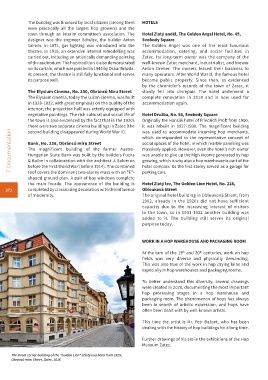
      The street corner building of the "Golden Lion" (Zlatý lev) hotel from 1929,
      Obránců míru Street, Žatec, 2016

