


Page 355 - UNESCO_Zatec_2021_A4
P. 355
7.c       FORM AND DATE OF MOST RECENT RECORDS OR INVENTORY OF PROPERTY


                                                            itself  only  hundreds  have  been preserved.  Hence,  the
          7.c1     ADDITIONAL OUTCOMES OF THE               documentation performed within the project has been
                   PROJECT NAKI DG16P02B021                 regarded the last possibility of recording these buildings
                   DOCUMENTATION OF THE                     for the future. As part of the basic documentation of the
                   HISTORICAL BUILDINGS FOR HOP             buildings, the identification, photo-documentation, the
                                                            documentation of the specific construction solutions,
                   PROCESSING (2017–2020) –                 technological equipment and technological state of
                   COMPONENT PART 01                        proving the hops processing, the land surveying, the
                                                            construction measurements and sample collection
                                                            for dendro-chronical dating of selected buildings was
          This chapter is supplementary to the information given in   performed. The archive research was part of the study
          the Chapter 5.f3, part "Support for research activities" (for   as well.
          more, see the Chapter 7.c2).
                                                            Based on this evidence a special map (see bellow) and
          The main focus of the project NAKI DG16P02B021    IISPP/GIS NPÚ (Integrated Heritage Information System
          (Documentation of the Historical Buildings for Hops   of National Heritage Institute), basic database was
          Processing) which was implemented by the Regional   established. A  highly easy-to-use system was created
          Office of the National Heritage Institute was to perform   using sophisticated technology - phones with cameras
          a  basic documentation of the historical buildings for   and GPS modules, tablet PCs, remote network access to
          hops processing in the countryside of the whole Czech   the external scanned document storage and remotely
          Republic. These buildings are part of architectural   accessible GIS and MIS map databases.
          assets bound to the specific natural conditions occuring
          only in some regions (see the Comparative Analysis,   This  system  enables  operational  field  documentation.
          3.2.a). These conditions constitute an important part of   Moreover, based on this experience a  methodology
          the urbanism of towns and cultural countryside. Since   called Metodika efektivního terénního průzkumu
          that project, there has not been given  any  scientific   a  dokumentace historických staveb (Methodology of
          attention to the development, function, constructions   effective field research and documentation  of historic   355
          or the technological equipment used on such buildings.   buildings) was created that describes the use of this
          In addition, these buildings (except for several ones) are   widely available technology in basic field historical built
          not legally protected. With respect to size, these buildings   documentation. The full version of this publication is
          are of a great financial burden to their owners and have   available here (in Czech).
          lately been subject to a large scale of demolition. Out
          of more than 5,500 of these buildings evidenced in the   https://www.npu.cz/uop/usti-nad-labem/projekty/chmel/
                          th
          beginning of the 20  century in Saaz hop growing region   lipenec113a114/chmel%20metodika_8.pdf


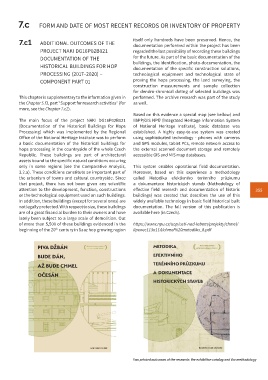
                                                            Two printed outcomes of the research: the exhibition catalog and the methodology

