


Page 177 - UNESCO_Zatec_2021_A4
P. 177
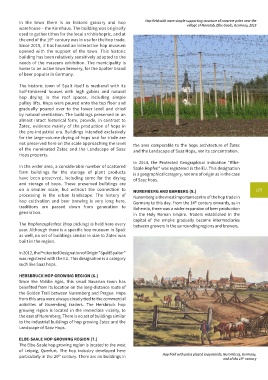
In the town there is an historic granary and hop        Hop field with more simple supporting structure of concrete poles near the
          warehouse – the Kornhaus. The building was originally                     village of Monstab, Elbe-Saale, Germany, 2013
          used to gather tithes for the local archbishopric, and at
                        th
          the end of the 19  century was in use for the hop trade.
          Since 2015, it has housed an interactive hop museum
          opened with the support of the town. This historic
          building has been relatively sensitively adapted to the
          needs of the museum exhibition. The municipality is
          home to an active town brewery, for the Spalter brand
          of beer popular in Germany.

          The historic town of Spalt itself is medieval with its
          half-timbered houses with high gables and natural
          hop drying in the roof spaces, including simple
          pulley lifts. Hops were poured onto the top floor and
          gradually poured over to the lower level and dried
          by natural ventilation. The buildings preserved in an
          almost intact historical form, provide, in contrast to
          Žatec, evidence  mainly of the production  of hops in
          the pre-industrial era. Buildings intended exclusively
          for the large-volume drying of hops and for trade are
          not preserved here on the scale approaching the level   the area comparable to the hops architecture of Žatec
          of the nominated Žatec and the Landscape of Saaz   and the Landscape of Saaz Hops, nor its concentration.
          Hops property.
                                                            In 2014, the Protected Geographical Indication "Elbe-
          In the wider area, a considerable number of scattered   Saale Hopfen" was registered in the EU. This designation
          farm buildings for the storage of plant products   is a geographical category, not one of origin as in the case
          have been preserved, including some for the drying   of Saaz hops.
          and storage of hops. These preserved buildings are
          on a  smaller scale, but without the connection to   NUREMBERG AND BAMBERG (8.)                          177
          processing in the urban landscape. The history of   Nuremberg is the most important centre of the hop trade in
          hop cultivation and beer brewing is very long here,   Germany to this day. From the 14  century onwards, as in
                                                                                        th
          traditions are passed down from generation to     Bohemia, there was a wider expansion of beer production
          generation.                                       in the Holy Roman Empire. Traders established in the
                                                            capital of the empire gradually became intermediaries
          The Hopfenzupferfest (hop picking) is held here every   between growers in the surrounding regions and brewers.
          year. Although there is a specific hop museum in Spalt
          as well, no set of buildings similar in size to Žatec was
          built in the region.

          In 2012, the Protected Designation of Origin "SpaltSpalter"
          was registered with the EU. This designation is a category
          such like Saaz hops.


          HERSBRUCK HOP GROWING REGION (6.)
          Since the Middle Ages, this small Bavarian town has
          benefited from its location on the long-distance route of
          the Golden Trail between Nuremberg and Prague. Hops
          from this area were always closely tied to the commercial
          activities of Nuremberg traders. The Hersbruck hop
          growing region is located in the immediate vicinity, to
          the east of Nuremberg. There is no set of buildings similar
          to the industrial buildings of hop growing Žatec and the
          Landscape of Saaz Hops.

          ELBE-SAALE HOP GROWING REGION (7.)
          The Elbe-Saale hop growing region is located to the west
          of Leipzig, Querfurt. The hop industry developed here
          particularly in the 20  century. There are no buildings in     Hop field with poles placed in pyramids, Nuremberg, Germany,
                           th
                                                                                                             th
                                                                                                    end of the 19  century

